no
As the deadline for the 2026 Martirano Memorial Award approaches, Victor Zheng, Coordinator of the Martirano Award and a School of Music alum (DMA ’23), presents a series of conversations with the three 2025 winners, offering a unique glimpse into their approaches to composition, inspiration, and musical imagination. The featured composers are First Prize winner Paul Novak, Second Prize winner Jonah Nuoja Luo Haven, and Third Prize winner Ess Whiteley.

Paul Novak
Paul Novak (he/him) is the First Prize winner of the 2025 Martirano Award with his work seven dreams about my body (2024) for microtonal sextet, in seven miniature movements.
seven dreams about my body (2024)
-
- dream in which i float on a black sea (for toru takemitsu)
- dream in which my body is a flock of birds (for ben johnston)
- wasps’ – nest – dream (for gyorgy ligeti)
- dream in which my body is a constellation (for kaija saariaho)
- dream in which my body is clockwork (for unsuk chin)
- teeth – falling – out – dream (for andrew norman)
- dream in which i cannot walk (for anthony cheung)
Victor: I’ll start with a question I ask all of these winners here, which is – just tell me about the premise of your piece, as best you can put it succinctly.
Paul: Yeah, absolutely. So, my piece is called seven dreams about my body. And the real inception of this piece started back in 2020 because around the summer and fall of 2020, I started to keep a dream journal. And this began not out of any particular type of dream interpretation that I was interested in, but more that I thought it was a really interesting concept, artistically. I started to keep this kind of catalog of images from dreams that I had during that time, and it’s a catalog that continues in a kind of incomplete way to this day. That catalog has been the source of a bunch of pieces I’ve written in the last few years. The first one was a vocal piece called dream catalog. There was another piece called two dreams about water, and then eventually this piece which is called seven dreams about my body. It’s a piece in seven movements, where each of the movements takes as its inspiration a weird dream I had during this time. I think, like a lot of people during the pandemic, I had such vivid and bizarre dreams about my body during that time. There’s a movement of the piece where my body becomes a flock of birds. There’s a movement of this piece where I was imagining getting attacked by a swarm of bees. Very, very vivid and visceral sorts of images.
Victor: So you mentioned that this is not the first piece you’ve written related to your dreams in some way, right? Is there anything that made this one special?
Paul: I think one thing that at the time was very new for me but is something that I’ve continued to explore quite a bit since I wrote this piece is the microtonal language that it uses, and for me in particular, I associate microtonality very specifically with somatic experience because for me I think microtonal harmony often kind of confounds my normal ways of hearing pitch. Oftentimes I feel it in my body much more than I can hear So I was really happy with how that worked out in this piece. It’s a piece for Pierrot sextet, and the pianist doubles on a microtonally tuned keyboard, a keyboard that’s tuned a quarter tone up. It uses a variety of different microtonal approaches. Some of those approaches involve using different microtonal modes and scales, and also different types of microtonal gestures.
Victor: So this is the first time you used microtonal language significantly; before that, your dream pieces were still in the equal temperament idiom?
Yeah, pretty much.
Victor: You got the digital keyboard; that puts this pianist kind of front and center. You have the pianist playing simultaneously on the piano and the keyboard, and a lot of the time you have one hand on each, right. You also specify 453 Hz, 50 cents. On the one hand it’s 24 EDO, but on the other hand it’s just 12 EDO and then a different 12 EDO?
Paul: Yeah, exactly. So, basically, it’s a way to get to 24 EDO. But I think most of the time, I’m really going for this sort of blurry effect, a dreamlike effect, I would say. So, it’s not about the specifics. Oftentimes, it’s more about creating this blurry sensation across the whole ensemble. And I think the way that I treat microtonality in terms of the orchestration of the ensemble, a lot of times it is more about creating a sensation of something being slightly off than it is about any specific tuning system or any very particular just intonation system or anything like that.
Victor: It’s really clever the way you managed to put the piano front and center, especially with the way that the piano translates well into an electronic keyboard, which is probably the most ubiquitous electronic instrument out there. It almost gives this kind of a piano concerto effect, doesn’t it, because of having a such a visible, obvious setup. It simultaneously makes the piano one of the driving forces that gives us this blurry effect like you say, because it’s operating both simultaneously and easily on all sides of the equation. It’s really easy for the piano, because the keyboard is such a ubiquitous electronic instrument, right? A couple of times you have the flute, for example, pull up the headpiece a little bit, and obviously, it’s possible for a violin to just play consistently in microtones, but it’s still the piano that has the most visible effect, right? So that gives us kind of a piano concerto effect. Is that intentional?
Paul: Yeah. I think both in terms of visually, how it’s set up on stage, and I think also musically, the piano is really at the center of this piece, where there are several of the movements that are almost like mini piano concertos just like you said. The first movement especially, it begins very free, rhapsodic, kind of like [Claude] Debussy in microtonal harmony. That movement is also dedicated to [Toru] Takemitsu too. So it’s sort of very much in this free very French-Japanese sort of sound world. I think of the microtonally tuned piano on a very practical level. I think it’s very intuitive for pianists to play because it’s very much like having two different manuals of an organ or of a harpsichord, right? Basically treating it as like different manuals of the same instrument. And the effect that I’m going for is of one blended sound between the piano and the digital keyboard. So it should almost be like an extension of the sound – or a prosthetic of the piano is another way of thinking about it. This is kind of a thing that I am very interested in, and there is a performance artist who I’m friends with named Katya Petetskaya, who is creating a performance piece to accompany seven dreams about my body. And her approach in creating a piece to accompany it is to take the prosthesis very literally. So she attaches these gigantic tubes to different parts of her body and extends her body in that way. And I thought that was a really interesting thing, just to make this auditory prosthesis into a physical prosthesis.
Victor: Is that something that she was responding to, like you mentioned the prosthetic theme – is that idea coming from you or her?
Paul: More naturally, I think, from our conversations.
Victor: So it’s like a synergetic imagery that results from your collaboration.
Paul: Yeah. Exactly.
Victor: I thought it was really interesting the way you talk about prosthesis as opposed to blending. To me, the immediate impression was that they seem to be a little bit different, divergent ideas. One, I would imagine, as just like an extension, like a natural extension, versus prosthesis, which might, to me, imply something a little bit artificial, added on, unfamiliar. And I imagine since you used both words, you might be calling for a blend of both ideas.
Paul: Yeah. I think in different movements, I treat it in a different way. I think part of it is because some of the dreams have kind of a more naturally oriented kind of vibe, and some of them have a more artificially oriented vibe. In particular, there’s one movement called “dream in which my body is clockwork,” where prosthesis becomes maybe more literal, like thinking of cyborgs and that sort of thing.
Victor: You take it to varying degrees of literalness. That connects to one of the questions I prepared for you: sometimes, like such as “wasps’ – nest – dream,” things are overtly onomatopoeic; I could hear you evoke these buzzing insects very, very well, whereas something such as “teeth – falling – out – dream,” that’s a little bit less conducive to direct sonic representation. So, you’re going to have to make it a little bit more abstract, maybe more impressionist; you mentioned Debussy. Can you talk a little bit more about how you depict these dreams; what exactly are you going for?
Paul: Yeah, I think you’re spot on that some of them are very literal; the bees one, to me, just had such an obvious sonic quality to it. And then I think others were sort of less direct representations. For example, you mentioned the teeth falling out dream. I was thinking about this gesture, just of things kind of melting, and trying to go for this surreal kind of quality. And so the overall central gesture of that piece is this microtonal glissando, this idea of everything kind of melting at different times into each other. But I would say that for me, one of the things that’s most satisfying about this form of piece, of writing miniatures, is that each movement can really have just one central idea or gesture which develops over the course of it. And I think for me, there’s something so satisfying about writing a piece like that too which only does one thing, or maybe two things, and then stringing them together into a longer cycle of pieces.
Victor: I agree with you – writing miniatures, when done well – which I really believe yours are, they just have one idea each with all the necessary focus, and then says what it means to say and goes away. And every single one of them, you give this reference with the title, right – it does something evocative of what you’re talking about. I think you described it very well, the way you take advantage of the miniature form but like still create a large-scale form with multimovement structure. So it still feels like it has plenty of variety going on and different vignettes about different things. I really thought that was really, really effective.
Paul: I appreciate that. I mean, I think in creating a longer cycle like this, something that I’m always thinking about is contrast, right? It’s trying to make sure that when you have something in seven movements, you want to make sure it has both a longer arc but also um every single part of it is different from the other ones too.
Victor: And arcs within each movement, right?
Paul: Yeah. Exactly. Actually, this cycle of miniatures um actually fits into a larger, in-progress song cycle that I’m working on, which I will probably be working on for a long time, but is a very personal kind of autobiographical cycle of pieces. The working title of it is when I was nine, I couldn’t walk,and this is a cycle that had its inception from this same dream project, because in 2020, one of the recurring dreams that I had was a dream where I was in a wheelchair in the hospital, and I couldn’t walk, which is the title of the last miniature in [seven dreams about my body], “dream in which I cannot walk.” This was a fascinating recurring dream to have because there was a time in my life where I was in a wheelchair in the hospital, and I couldn’t walk. But I know that only from what I’ve been told. I have no memories of that. When I was 9 years old, I started having these very strange symptoms where I became very dizzy. I was unable to walk. I slightly lost my ability to speak, among other odd symptoms. And doctors ran all sorts of tests, and what they eventually discovered is that it was a psychosomatic illness. So there was nothing physically wrong with me. From this kind of rediscovery of this illness that I had had as a kid, I have become very interested in psychosomatic illnesses, both in the history of them and the different theories of them, psychoanalytically and medically. In particular, I’ve become very fascinated by the history of the patients who were treated with hysteria at the end of the 19th century by [Sigmund] Freud and his contemporaries, because many of the young women who were treated for hysteria had very similar symptoms to me, and I think a very crucial detail in the cycle is that most of these young women, we have nothing from them in their own words. I mean, their case studies are very well documented because of Freud and [Joseph] Breuer, and these other doctors who are treating them, but actually the only thing we have from them in their own words is their dreams, because of Freudian dream interpretation. So this cycle is still a very long-term project that I’ve only written a small portion of, but one of the big parts of it has been setting the dreams of these hysterics to music, and seven dreams about my body will be the instrumental interludes in that cycle. So between the vocal parts of the cycle, between the song sections.
Victor: So you’re treating seven dreamsas like a part of a larger scale project that you are currently working on expanding.
Paul: Yeah, exactly. So of the concert length song cycle, these are the instrumental interludes.
Victor: And did you envision this as part of a song cycle in the beginning, or is this just like kind of something that organically developed as you writing?
Paul: I think it always was going to be interludes of something. Actually, there was an earlier version of this piece that was only five movements, but was called somatic interludes. So I think I always envisioned it as these little interjections between something longer. I think the cycle has become much bigger in scope than I originally planned it – it will be my doctoral dissertation. Although – I may or may not actually finish the whole cycle during my doctorate so I’m not totally sure. But it’s also a piece that I feel so much gratitude for, the collaborators who have helped to make it exist so far. I mean, it’s this super ambitious and super personal kind of project. And in particular, there are two ensembles that are groups that I have a very close relationship with, that have been bringing to life different parts of the cycle as I finished them. I think really, that’s a testament to our trust in each other. Those two ensembles are the New York-based Blackbox Ensemble and then the group Mycelium New Music, which I’m the co-artistic director of in Chicago.
Victor: You mentioned trust, right? I guess this is a very personal project, and to trust an ensemble to interpret this means trusting them with part of yourself, especially for something with such a personal subject matter as this, right?
Paul: Yeah absolutely. I think you really hit the nail on the head with that. For me, this is a sort of uniquely vulnerable kind of project. I think a lot of my music is not autobiographical in this way. Sometimes I joke with other people that this is my most egotistical kind of project too, just because, I think I think a lot about collaboration, and I think that for me, most of the music that I write is really for other people. Like, it’s a testament to our collaborative process and our friendship, and I’m thinking a lot about the kind of music that they want to play and that will fit right in the program that they’re putting together. Whereas this cycle, I think is one of the first things I’ve done that really is fully for me, like it’s a project that I feel that I need to write, and so that’s why I think it means so much to have the trust of these groups just bringing it to life in parts.
Paul: It’s a very unique and rewarding and rare kind of a trust to have in someone, that artistic level of trust.
Victor: It is, yeah. And I think that those are the sorts of collaborative relationships that I’m really interested in, the kind that can blossom over many years and bring to life these sorts of very special projects that couldn’t happen just in a one-off kind of commission.
Paul: Getting a little philosophical, then. You’ve talked at length about how personal this subject matter is to you. All of these dreams in seven dreamsrepresents a certain dream that you remember having, right? To what extent do you feel these dreams reflect you?
Victor: That’s such a good question, and I think it’s a complicated one because I think from the way that I understand dreams, they represent so much, and they also represent nothing at the same time. I think that my interest in dreams really started after I read this book by Ayad Akhtar called Homeland Elegies. It’s an amazing book, a kind of autofictional novel where he describes his very specific process of keeping track of his dreams and journaling about them. And he says something to the effect of keeping track of his dreams is dwelling along the weave to get at the really vital stuff artistically. Basically, just that if you’re thinking about your dreams, you’re going to be thinking about the stuff that’s really important to you, and it’s like a window into that. And I really agree with that, too. I think that in terms of the specifics of different practices of dream interpretation, I think I’ve learned a lot from several different practices, but there’s nothing specific that I necessarily subscribe to.
Victor: So you’re thinking somewhat generally about how these dreams might represent you. You’ve had these dreams in one way, and like you mentioned, “a dream in which I cannot walk” represents a specific experience you’ve had, whereas the other ones might not directly, but they all, according to this book, they all represent you in some way and it’s up to you to figure out how.
Paul: Absolutely. I mean, I think there’s a way that this piece is kind of a self-portrait in a certain way, but like maybe a self-portrait in, like, a funhouse mirror or something. It’s very surreal. It’s unclear what’s real and what’s not and it’s very maybe distorted or oblique.
Victor: I guess I have to go back because like you mentioned this and we can’t leave without fully addressing it. You mentioned there was a dedication to Takemitsu?
Paul: So each of the seven movements has a has a dedication to a different move or a different composer whose work has had a big effect on me. And this was sort of a fun thing – I was thinking a lot about these composers as I was writing the movements, but I actually added the dedications after the fact. The first movement is dedicated to Takemitsu, who’s the composer who probably has had the biggest effect on my music in my life. There’s a movement dedicated to Ben Johnston, who is a composer who’s really had a huge effect on the way I think about microtonality. There’s a movement dedicated to Unsuk Chin, to [Kaija] Saariaho, to Anthony Cheung. These are all composers whose work I really admire, and I think all of them, maybe some in very direct ways, some in maybe less direct ways, have had a huge effect on this piece.
Victor: That’s really fascinating. If you choose to make these overt references to these composers who have influenced you in certain ways, it really makes you yourself think about what that might mean for you as a composer. It’s really nice for you to acknowledge some sort of musical lineage of inspiration.
Paul: Yeah. I love thinking about lineage in that way, and I think for me, microtonality is such an interesting window into that, too. I mean I think that, already thinking about the music of someone like Anthony Cheung for example, to me, so much of it has this very impressionist spirit, but it’s all filtered through this very specific microtonal lens. And just thinking about that kind of lineage and how I fit into it is something I’m very interested in, too. I think it’s also really important to acknowledge the people who’ve affected you, too.
Victor: I completely agree with that. I love the idea of like we’re all part of a big family and we all inspire each other in some ways. We don’t necessarily have to be officially studying under them, we don’t have to have met them, but having them touch us in some ways, it’s just humbling, right?
Paul: Yeah, it really is. I like that. It is humbling.
Victor: I guess we have time for one more if that’s all right with you. Some years ago, you were the honorable mention. So, what was it like coming back as a winner?
Paul: I had such a blast being at UIUC. I mean, I was only there for maybe 36 hours, so it was definitely a whirlwind, but I had such a great time meeting a bunch of the students and meeting the faculty and working with the new music ensemble [Illinois Modern Ensemble] who had been working on my piece, which is a very challenging piece, for a couple weeks already and had already had so much growth and really sounded fantastic on it. I think some of the highlights of that kind of residency in Urbana were giving a presentation to the composers to the composition studio there and just getting to hear everyone’s really thoughtful interpretations and thoughtful questions about my work. Yeah, I had such a blast being there. And I’m really grateful to the Martirano Award for making that happen, too. That sort of experience and even this kind of interview is something that we don’t get all that often as composers, to just have a chance to talk about our work, and have an audience in that way. I appreciate it.
seven dreams about my body as well as Paul’s other work can be found at paulnovakmusic.com.


Jonah Nuoja Luo Haven
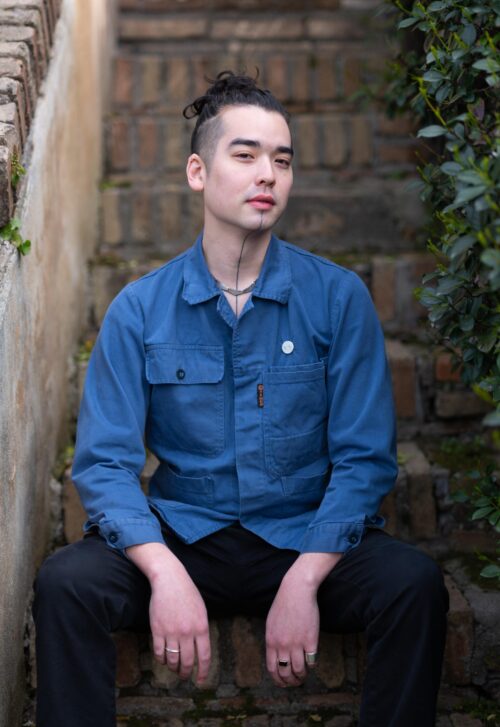
Jonah Nuoja Luo Haven (he/him) is the Second Prize winner of the 2025 Martirano Award with his work laugh radish (2017) for string quartet.
laugh radish
I wish I could say this is about hunters, but I do not like hunting. I want to say it’s about this map of time in the sky, how each star’s light reaches Earth a little later than the other. I would like this to be about an ocean or a heart or a tree. But the instinctive expressions of happiness have pressed this to be about radishes. The spontaneous sounds and movements of the face and body, those swollen, pungent-tasting roots that are small, spherical, and red — I gather them. My heart moves toward them like slow summer rain in the distance. The colors yellow in the warmness. I tell you I want to be one, sticking out of the ground like a tongue. All I can think about is eating radishes raw with salad.
Victor: I peeked at your program notes, and it’s very beautifully written about a number of different things; how you arrive at that that the “radish” theme? Could you talk a little bit about the title and the program notes?
Jonah: Yeah, it is very personal, as you said. This piece really didn’t want to be titled, I have to say, and it was quite a long time ago. I started writing it just under 10 years ago, so it’s kind of an earlier work. I was writing it for the Vois Nouvelles program at Royaumont. And I had to write a string quartet, which was going to be my first string quartet. I had written one before, but this one I still consider my first. This was quite daunting for me because string quartet is such a huge genre, and I wanted to title it something having some kind of…poetic “thing.” But what ended up happening is all I could think about was eating radishes with my then boyfriend and now fiancé. So – eating radishes in this really, deliriously hot heat and laughing, just sitting on the kitchen floor in Boston. And so, I decided that – okay – this piece will just be called laugh radish.
Victor: That’s really beautiful – it really reflects a very significant time of your personal life, right? And a seemingly a small detail, mundane detail, but really poignant to your lived experience, is my impression. Is that right?
Jonah: Yeah, definitely. I mean, now that I’m looking back and thinking about that piece, it sort of started a lot of thinking about everyday moments and how seemingly simple they are, but in reality, those moments hold infinity and actually can be the most spiritual. So it started this whole throughline, I guess, in in my work.
Victor: The most immediate thing that jumps out obviously is the range of techniques going on here. I’ll tell you my initial impression – you can tell me if I’m right or not and you can elaborate on it. My impression so far has been that first, you have this wealth of different bowing pressures, bowing speeds, bowing positions, bowing techniques, and that seems to inform the form of your piece. It opens with a variety of glissandi, there are long stretches where it’s mostly focused on harmonics, long segments where it focuses on just variations in bow pressure, long tones, etc. Is that accurate?
Jonah: It probably is. It wasn’t so conscious while I was writing it. I had a lot of trouble with form with this piece. I kept adding sections, taking them away. And it is true that the piece has so many techniques. I guess I kind of think of it as like a circus that is going wrong. And the performance of it, it’s really, incredibly difficult to play because you’re just switching bows, switching techniques, switching mindsets, really constantly, almost. And there are these stretches where things do stay, but they aren’t very long. So, the players have to think constantly of the next thing while still somehow remaining present. But yeah, the form – it was a total mess, actually, but that kind of was very important for me, that the form was kind of erratic, that it didn’t want to stay in one mode for too long. And I think that reflects the kind of heat that we were experiencing in Boston. We couldn’t sit still, and it was just kind of a manic time.
Victor: I love the way you put it, the constant switching, the total mess. It’s a funny thing with composers – like, it’s never a given that the terms that are usually negative are actually negative. You’re using it in a very beautiful way. You’ve harnessed this kind of chaos in a way that comes through and expresses a happy time in your life, if I’m interpreting correctly.
Jonah: Right, yeah, for sure.
Victor: And the constant flux you were talking about, the constant switching – you mentioned the few moments where things stay still; the rest of it is this kind of continuous flux, is that right Is there a sort of thematic or moral significance behind the moments that stay still?
Jonah: I guess the near the end there is this – I view it as a sort of “sky” that suddenly you’re dropped into. It’s harmonics with ordinario notes, and also using this kneadable rubber to create multiphonics, and it’s that 25-second bar. So, this was the last thing I added into the piece and the form, because it was just a bit too dense – it comes right after a pizzicato section, and originally, I just went straight into the ending with the soft putter of the entirely detuned cello string.
Victor: The one where you manually detune down.
Jonah: But this I added in at the last second because even though it’s still incredibly dense in color, it afforded the piece some kind of breath. It breathed just a little bit before ending. And I sometimes think about that measure still, and wonder if it should have been maybe six times as long, but I think it still serves its purpose there.
Victor: For what it’s worth, I thought it was beautiful when I listened to it. It really did convey what you’re talking about, the stillness. For me, it felt like a moment of calm – there’s so many things happening, so many different sections that all have their own thematic flux to it, yet this one I get to sit back and just listen to the colors kind of peek through as for once, gesturally, things are just really sitting still. It’s a kind of state of beauty in that it’s as if I’m running through the woods versus standing and watching the river. I think that it was a really inspired moment. I guess that’s a segue into another thing I want to ask about, and the elephant in the room, because that’s the first thing you mentioned in the technical notes, the scordatura. How did you design that?
Jonah: So, I guess this was this piece was very important for me because I think it was one of the first pieces I used scordatura. This was the first piece that in which I used something I call star maps, which are – I lay out the natural harmonics on a sheet from how they’re fingered to how they sound. And so, with the scordatura, you can achieve all these very different results from ordinario, double stops, and triple stops, and quadruple stops later on. This piece, I think, only uses double and triple. I just arbitrarily chose these pitches and then made this these star maps for each string. And then, from there, I adjusted the fundamental note to get the intervals or the chords that I was hoping to get. So it’s again, quite a messy process. It wasn’t like, “okay, I want these four pitches for these four instruments.” It wasn’t so clear-cut.
Victor: Yeah, I like that. It doesn’t have to be any significant meaning attached to each individual pitch. Sometimes these things are less tangible, right? They have to go by the feel of what you’re looking for and then work from there, right?
Jonah: Yeah, definitely.
Victor: Star maps. Does that reference the second line of your program notes here? “I want to say it’s about this map of time in the sky, how each star’s light reaches Earth a little later than the other.”
Jonah: Yeah, I guess so. Back then, I was very excited by this idea, or this truth, that we see in the sky just an unimaginable amount of times. We’re looking into the past when we look at a star because light takes so long to travel to Earth. And this idea, I suppose it is related to the star maps because I called them that for some reason. But I really like that idea. It makes me feel very small in a very good way, and also very lucky to be able to witness light travel such extreme distances. I think it’s another happy thing that I wanted to put in the piece.
Victor: Did you coin that term, star maps, for harmonic charts?
Jonah: Coin it? I don’t know. I guess I haven’t used that term in a long time.
Victor: You didn’t get from anywhere?
Jonah: Oh, no. I just kind of thought – I love natural harmonics so much because – I mean – they’re so finicky, which I love. They don’t always sound, and it really depends on the instrument, the string, the bow, the player…and that kind of unpredictable nature is something very exciting. And in addition, a lot of them in my work that I use are lower on the strings, so they’re even harder usually to come out and especially with prepared bow and all these other techniques. Down there, they have a different color than achieving them higher up on the strings, and it’s a little bit more vocal and a little bit redder or warmer, I guess…no, warmer is not right. It’s more woody and round, somehow. So those two elements remind me of stars a lot. The way that they flicker and the way that there are so many unknowns with stars.
Victor: You said redder – is that speaking from a kind of synesthesia? Are you associating colors with sound?
Jonah: I think it has to do more with associating color with feeling. I don’t have synesthesia, but I do feel colors somehow. I don’t think it’s synesthesia; I think it’s just an emotional response to color.
Victor: It’s a way of abstractly expressing things that maybe aren’t inherently sonic but have some sort of emotional significance or symbolic significance in your experience, right?
Jonah: Yeah, definitely.
Victor: And I like the way you talk about the scordatura, with how important harmonics are in this piece. The scordatura itself determines the context around which your natural harmonics take place, right? Especially when dealing with natural harmonics, they’re all open string. So that means that, in my interpretation, that would make the moment near the end of the piece that you referenced earlier, the detuning, all the more significant, because that takes the most basic organizational constant of the piece, the strings, something that’s so important thanks to how extensively you use the natural harmonics, and then recontextualizes that as well. It’s almost as if you’re like warping time itself as you approach this the ending of the piece. Did you view it in a similar significance?
Jonah: I think that’s very beautiful. I was definitely trying to manipulate “time-feel” with this piece. Its fast changes and gestures and the ending, you know, it sort of spreads out a bit, and back then, I was attempting to sublimate the material smoothly, which I don’t think the piece does very well. But within that attempted sublimation, I wanted to, you know, fundamentally change one of the instruments, so to break its tension. So that was the idea behind that. And what it does to time, it’s hard to say, because for me, that was such a decision that I made, that when I hear it, I know the piece is ending. So I can’t quite analyze it in in a way that has any kind of distance. Even with these 10 years on from writing it, it still signifies the ending for me. It’s like this “we’re done here.” But it’s interesting to hear you say that it affects time in that way.
Victor: I guess I view time as some one of those basic constants of life. It’s always happening. No matter what you’re doing, time is passing, right? And with the tuning being so fundamental to the piece itself, the construction of it, messing with something so fundamental is analogous to messing with time in real life, theoretically, if I could. You mentioned the moments of flux, time standing still versus time moving. I think the way you talk about time is very poignant and beautiful. The way it really is just controlling the flow of experience as you listen to it. Where time seems to be passing faster, slower and in some cases completely stop, and in my interpretation, maybe get fundamentally warped near the end. But you also mentioned that after all these years, your life has changed, experience has changed, but having that moment there is so striking that it still maintains its temporal function of ending the piece. Is that right?
Jonah: Yeah, I think so. It’s interesting to look back at this piece now because I’m actually writing a piece that’s kind of coupled with it right now, which is a happy coincidence. The title for this new piece comes from the program notes [of laugh radish]. I think it’s the penultimate line: “I tell you I want to be one sticking out of the ground like a tongue.” And so, it’s quite a long title. I got rid of the comma in the middle.
Victor: Oh, that’s the title!
Jonah: That’s the title. Yeah. I hope it will fit on the program.
Victor: “I tell you I want to be one” – be one as in be a radish?
Jonah: Yeah, exactly, in the context of the program notes, but in this new piece, it’s more loose. So “I tell you I want to be one” can be I want to be something or I want to be one with something. And then sticking out of the ground like a tongue without the context of a radish is a little bit more morose, which is the idea, I guess. Both of these pieces are about my relationship with my partner, Alex. And I rarely write about joy, which is something that I am trying to change because it’s definitely more fun. I think laugh radishand this new piece are definitely about joy and about these everyday moments. This new piece is for Yarn/Wire. It’s an amplified quartet. It’s for two pianos, two percussion. All of the percussion is everyday objects from our lives. I’m still in the middle of writing it, but the piece uses our water bottle.
Victor: Oh, that sound never gets old.
Jonah: So, I’m just very much exploring every sound this thing can make. And I hope that the joy of our relationship – it’s not focused on water bottles, but this everyday act, very simple, getting water for each other. I mean, it sounds so silly saying it out loud, but it is very special.
Victor: That’s beautiful – that’s a very beautiful way to wrap things up here. I appreciate all your personal candor. I wouldn’t have known this beforehand, how significant laugh radish is to you – it’s about a very significant time of your life and all the ways in which you express the small things that made up such a happy experience. I can tell this was a significant piece for you and I really look forward to when you finish the companion piece.
Victor: Yeah, thank you so much. I have a strong fondness for this piece.
Jonah: And I imagine you’ll have it for the next one.
Victor: I hope so.
laugh radish and Jonah’s other work can be found at jonahhaven.com.

Ess Whiteley
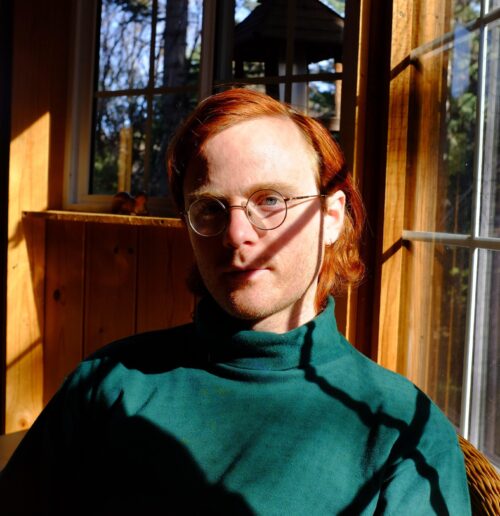
Ess Whiteley (they/them) is the Third Prize winner of the 2025 Martirano Award, with their work Machine Spectre (2024) for chamber orchestra and electronics, which includes not only digital electronic sound but an assortment of electronic hardware including cassette player, CD player, and mechanical keyboard.
Victor: I’ll open the floor to you – tell me about the premise of your piece, Machine Spectre.
Ess: So, Machine Spectre– I was really thinking about the materiality of technology and kind of the agency that technology has over the human, as a sort of co-mingled subjectivity – human and technology. And I was really interested in sort of creating a musical cyborg, if you like, or creating a sound world that was sort of drawing attention to the unnoticed invisible agency of technology, and the tensions that exist between human agency and technological agency. That was really sort of the starting point – I was interested in kind of creating this effect of the materiality of technology sort of coming to life and having a very kind of vibrant, audible sense of agency and making it sort of explicitly noticeable through sound. I wanted to kind of create this affect of outdated technologies, technological devices coming to life in a sense, like haunting the present.
Victor: I gather that’s what the term spectre is referring to. That’s a very good segue to the first specific question I want to ask, which is – you have a very fascinating assortment of “machine” sounds. First of all, you obviously have the fixed media cues which you control via Ableton, right? But also, you have the cassette player and the and the keyboard? These individual objects are either mic-ed, or the sounds that they are playing are part of the music itself. You’ve already mentioned a little bit about outdated technology. Can you elaborate a little bit more on what made you choose these particular ones?
Ess: I chose these sounds because they had specific affects of nostalgia and of memory. For example, the clacking of keyboard sounds – it’s not something that we’re all that used to anymore because laptops kind of have quieter typing sounds, right? I was interested in what these sounds evoke in the listener and the memories that they might evoke. I grew up in the 90s, and so for me, a CD player visually, as kind of an object is really loaded for me. The sounds of course, of the computer clacking, is very loaded for me. And then the cassette type player, I felt like there was definitely a loadedness in terms of memory with starting and stopping and rewinding – I mean, I didn’t grow up with the with the cassette tape player; that’s a little bit before my time. But I still felt it created the effect of something that is outdated, something that we’re familiar with but is kind of old. And the recording that is coming out of the cassette tape player is a recording from the 1930s. I also felt like it gave this effect of the past. There’s vinyl crackling. Combined with the cassette tape player, buttons turning on and off, rewinding, fast forwarding, it kind of creates this effect of oldness, an archaic technology. It has these has memories encoded into it.
Victor: Yeah, that’s actually, again, a really good segue into another question I had, which was – what exactly is the content of these recorded materials? You got the cassette recording, of course, and then you got the fixed media cues that you trigger in Ableton. And I guess one of the really striking effects to me when I was listening to the piece was just the clear unity. You specify that in the program notes, right? You want a balance between all of the electronic components and the acoustic components, right? And I imagine you wanted a little bit of ambiguity, at least at first glance, where these electronic sounds are coming from, whether it’s from the Ableton or the cassette tape, you’re linking them all to the same sound system anyway. So was it deliberate, then, all of these instrumental sounds that are playing largely the same very similar material? And did you design that to blend well with the electronics as a matter of compositional design?
Ess: Yeah, for sure. So, I was really interested in kind of creating this ambiguity between what was fixed media and what was live instruments. So to me, this kind of enhanced a sort of ghostly, haunted effect where you’re not really sure what’s coming from the loudspeakers. You’re not really sure what’s coming from the human beings. It also highlights the human-machine hybrid agency where you’re not really sure what is human, what is technology. So yeah, I really tried to make the instrumental parts mimic the electronics and the electronics mimic the instrumental parts. And really, it’s kind of this effect of, like, sleight of hand. You’re not really sure what’s coming from where. I really loved this kind of perceptual disorientation that that would happen as a result of this where you’re kind of in this sonic space that’s a little bit confused, what is coming from where, and it also feels enchanted at the same time.
Victor: So the technical background as to how the sound is generated is meant to be like somewhat hidden from the audience then, the audience isn’t supposed to see what’s being controlled via Ableton, what’s being controlled by – I mean, if they look closely, I imagine they could see, but it’s not supposed to be the front and center, right?
Ess: Yeah. And I think there was an aspect of that that was maybe intentional. The piece begins with the cassette tape player and I kind of was imagining it as being like a summoning. The sounds are almost like a séance – the ghost of the cassette tape player, of the CD player, with the inner electronics that are kind the glitchy machine humming and spinning sounds from inside of the CD player and the typing. The idea was that these sounds were sort of summoning the ghosts, the ghostly presence of the materiality of these objects. And then as it unfolds and builds, we sort of start hearing these other sounds, that we’re not really sure where they’re coming from, these invisible sound sources that are coming from the loudspeakers. The effect I was trying to go for was that the listener would then be convinced that all of these really maximal glitchy synthesizer sounds were this ghostly sound body that came from these outdated technologies, and their agency, their materiality, was made sonorous. But it was still like this kind of mystery.
Victor: I guess that plays out well with the ghost theme, right? Like maybe you can feel the presence. You can understand maybe conceptually what what’s going on, but like you’re not fully meant to unravel it because it’s supposed to be hidden from your experience.
So, what was on these? You mentioned there was a 1930s recording that you put on the tape, right?
Ess: Yeah. So that was a song by an American tenor who was quite famous at the time, named Richard Crooks, and the song I thought was thematically really spot-on which is why I chose it. The song is called “Song of Songs.” It’s kind of this meta song about music itself. It’s a song about songs, using the metaphor of song to represent longing and memory and nostalgia and love, and the way that song could be used to preserve memories of loved ones and how song can be used to preserve the memories of being in love. So I sort of used that as a starting point because it fits so well with the theme. The idea I was thinking of was that technology – these devices – were nostalgic for their own usage, or they were nostalgic for being relevant. It was almost like the cassette tape player was singing, like this cassette tape player was remembering the past, singing about its usage, singing about music. It’s singing about singing and what music can do to preserve memories. And so it’s kind of referencing itself in a way too. The piece is referencing itself, where it’s about sound being used to preserve things that are forgotten. Sound being used to act as a sort of sonic ghost.
Victor: The song itself isn’t really recognizable as you play it. If I recall, the cassette player is only in the first section, right? And you direct the first violinist to be operating the cassette player, just rewinding, fast forwarding it, ad libitum. You don’t specify exactly how to do it; it’s just going back and forth within it. So it’s more like it’s taking the song as sonic material. Maybe thematically referencing what the song is about, but like you’re not actually quoting a song in the traditional sense, right?
Ess: Yeah.
And you mentioned this is from the 1930s. I imagine that it came out in a different medium back then, right? You just happen to have a cassette tape rendering of it, is that right?
Ess: Exactly. Yeah.
Victor: So you’re referencing multiple levels of nostalgia here. First for the cassette tape as well as with the song being from a much earlier era. What about the CD and the fixed media? Obviously, the song is something that pre-existed, but what about the CD? Is that something that pre-existed? What about the fixed media?
Ess: So the CD player is not playing any actual musical material. The CD player has an electromagnetic microphone affixed to it, and it’s really only amplifying the sounds of the CD player’s electronics.
Victor: Oh, there’s no CD in there?
Ess: No, there is a CD in there, but you’re not hearing what the CD is playing.
Victor: Oh, okay. So it doesn’t really matter what the CD actually is. You’re picking up the actual sounds of the operation. You’re really emphasizing the device itself.
Ess: Exactly.
Victor: I guess that’s a similar theme with the computer keyboard?
Ess: Exactly, yeah. The cassette tape player, there was this evocation of the materiality with pressing fast forward and the clicking of the device itself, but it was also evoking memory through this song and kind of glitching. The way I treated the repurposed song was chopping it up and sort of randomly fast forwarding, stopping, playing. And I wanted to give the affect of feeling like the cassette tape player had its own sense of agency or its own sense of autonomy, right? It was glitching. Glitching can make us feel like the device is alive, like it we get a window into the device’s inner workings, and it’s not doing what the human wants it to do. It’s kind of doing its own sort of thing. So, I wanted to make the cassette tape player be glitching out, sort of, while it still had this loaded connotation of the old recording, the 1930s recording, which gives this an affect of “okay, this is an old recording. This is nostalgia.” Even though we can’t really understand the lyrics, we can’t really like recognize the tune, it gives us this affect of “Oh, this is old. This is the past.”
And then with the CD player, it was really about just highlighting the inner life of the material device, making its inner workings and material vitality perceptible and making its inner life sonorous. And the computer typing was similar. It was about just the sounds, what the sounds evoke, and then also just the materiality of the computer keyboard itself, the sounds of plastic. So it was kind of this mixture of nostalgia, what the sounds are evoking, and also the materiality of the devices and the sonorous kind of inner life of the devices themselves.
Victor: And so that leaves the fixed media then. Those are pre-rendered audio files, right? How did you go about making those?
Ess: Those were collages of modular synthesizer sounds, sounds generated from samples of acoustic instruments, and sounds generated from slices of “Song of Songs.” I was really trying to make this sort of hybrid, fused sound world of acoustic, electronic, old recording sort of feeling, like we were sort of tearing open this recording and tearing open the material technologies and hearing the circuitry. I wanted to give the effect that we were hearing the insides of these devices kind of glitching and exploding and erupting and unfolding in these chaotic sort of ways.
Victor: I guess that goes full circle too; one of your instructions says that everything is supposed to be balanced together as much as possible. So it’s really the fixed media sound files that you’ve made that really bridge everything together. The instruments blending well with these inherently non-musical sounds, right? The glitching, the electronic humming, the keyboard clicking, all that stuff. Somehow you got to put all of these sound materials together to make a composition and it’s really the fixed media doing the doing this bridging role. Would you agree with that assessment?
Ess: Yeah, definitely.
Victor: You have such a disparate, diverse way with electronics and then somehow, paradoxically, it’s still the electronics that holds everything together. I think that’s a clever way to create a very, very unusual and a very unique sonic world with all these with the different entities going on here. I guess I have one more question. How did you go about deciding who was going to operate what? Because you said the violinist is going to operate the tape player, the oboist is going to operate the computer keyboard. I guess the piano makes sense with the MIDI keyboard controlling Ableton, but what about everything else?
Ess: So, the violinist, I mean, I wanted the cassette tape player to be visible. I was thinking about staging. Same with the computer keyboard being on the furthest end of the stage. And then the bassoonist playing the CD player – I mean, there were kind of just practicalities; I could have given the double bass the CD player, and that probably would have looked better, but then again, I knew I wanted the double bass to be playing something earlier than I wanted the bassoonist to be playing something. So there was a little bit of figuring out the practicalities of things, managing what was going to happen when, and then thinking about the visual aspects of it. Also, ahead of time, I looked at the performers’ bios in Alarm Will Sound, and I was looking at who said they were excited about working with electronics. Because some performers can be maybe not so enthusiastic about being asked to do something other than playing their instrument.
Victor: Yeah, that’s respect for them as much as just trying to safeguard some of your own musical intentions, right? They don’t want to be thrust into a role that they don’t anticipate.
Ess: Right.
Victor: So as I understand it, it’s a mixture of practical but also staging reasons. If you want someone front and center, if the violinist wasn’t up for it, you probably would have given it to a flutist or someone who’s still similarly front and center for the cassette player, for example.
Ess: Yeah.
Victor: I guess that really ties in, a not necessarily musical element of it, but almost a dramatic aspect to the narrative of the piece. I guess we all love a good ghost story. And I think all of it really did come together into this very disorienting – I mean that in the best way possible – but ultimately very, very satisfying mix. That’s me saying on a personal note that I really enjoyed it.
Ess: Thank you so much, I really appreciate that.
Machine Spectre and Ess’s other work can be found at esswhiteley.com.