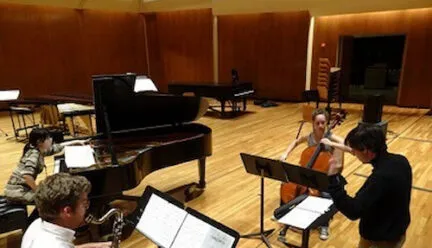
Illinois Modern Ensemble
Stephen Taylor and Carlos Carrillo, co-directors
Concert streaming can be found here.
29th ANNUAL SALVATORE MARTIRANO
MEMORIAL COMPOSITION AWARD
It is my great pleasure to announce the winners of the 2025 Salvatore Martirano Memorial Composition Award. The awarded composers and their works are as follows:
1st Prize: seven dreams about my body (2024) by Paul Novak
2nd Prize: laugh radish (2017) by Jonah Nuoja Luo Haven
3rd Prize: Machine Spectre (2024) by Ess Whiteley
Honorable Mention: through depths and shadows (2023) by Justin Weiss
The final judges for this edition of the competition were:
Marcos Balter
Fritz Reiner Professor of Musical Composition
Columbia University, New York, NY, USA
Carlos R. Carrillo Cotto
Associate Professor Composition/Theory
New England Philharmonic Composer-in-Residence
Co-director, Illinois Modern Ensemble
University of Illinois, Urbana, IL, USA
Juri Seo
Associate Professor of Music
Princeton University, NJ, USA
In addition to the cash prizes, the three prizewinning compositions are scheduled to be performed on the campus of the University of Illinois by the Illinois Modern Ensemble at the 2025 Martirano Award Concert on Tuesday, October 7, 2025, at the Foellinger Great Hall at the Krannert Center for the Performing Arts. The concert will be livestreamed via the University of Illinois School of Music YouTube channel. The composers will be invited to speak about their music at the UI Composers’ Forum and to attend a reception in their honor that will follow the award concert. Profiles and interviews of the composers will also be featured on School of Music news and social media.
Sincerely,
Eli Fieldsteel
Associate Professor and Chair, Composition-Theory-Technology Area
University of Illinois Urbana-Champaign
Composer Profiles and Program Notes
Paul Novak
he/him
b. 1998
www.paulnovakmusic.com
Bio:
The “spellbinding” (Washington Post) music of Chicago-based composer Paul Novak (b. 1998) immerses listeners in shimmering and subtly crafted musical worlds full of color, motion, light, and magic. His recent projects engage with dreams and memory, queer identity, climate change and the natural world, and psychosomatic illness.
Novak’s 24/25 season includes premieres and performances by American Composers Orchestra, Orchestra of St. Luke’s, the U.S. Army Band, the Balourdet, Molinari, and Lontano Quartets, Grossman Ensemble, cellist Alexander Hersh, conductor Mei-Ann Chen, and more. Other recent
collaborators include the Reno Philharmonic, Austin Symphony, Chicago Civic Orchestra, Music from Copland House, DanceWorks Chicago, Sandbox Percussion, Ekmeles, Quince Ensemble, Decoda, and Left Coast Ensemble. His music has been heard at Carnegie Hall, the Kennedy Center, New World Center, and Chicago’s Symphony Center.
Novak has received a Barlow Commission and an Underwood Commission, as well as awards from the ASCAP, BMI, the American Academy of Arts and Letters, Red Note, League of
Composers, and more. He has received fellowships from Aspen, Norfolk, Copland House, Millay, and I-Park, and was featured in the Washington Post’s “23 for ’23: Composers and Performers to Watch this Year,” where he was praised for his “impressive range and restless energy” in a catalog spanning “lithe, elastic vocal pieces…vibrant orchestral works…and evocative etudes for string quartet.”
Novak is the co-artistic director and flutist of Chicago-based ensemble Mycelium New Music, which launched its debut season in 2024. Originally from Reno, NV, he is a PhD candidate at the University of Chicago.
Winning Composition:
seven dreams about my body (2024)
Program Notes:
I had strange and vivid dreams at the beginning of the pandemic. Like many other people, I dreamt often about crowds, masks, and hospitals – and I also had odd recurring dreams about my body. In each of these seven dream-interludes, my body is not my body but something else. To capture the surreal, foggy atmosphere of these dreams, I extend the sound of the ensemble with a microtonally tuned keyboard.
seven dreams about my body will eventually serve as the interludes between the sung and spoken sections of my doctoral dissertation, a concert-length cycle of vocal-instrumental pieces which explores the intersection of queer longing and psychosomatic illness. This cycle draws from my recollections of a childhood diagnosis with “conversion disorder,” and will focus on the body and the things it unknowingly stores: memory, trauma, ache, desire.
* * *
Jonah Nuoja Luo Haven
he/him
b. 1995
https://jonahhaven.com/
Bio:
Jonah Nuoja Luo Haven (born 1995 in OH, US), laureate of the 2025 Luciano Berio Rome Prize in Musical Composition, is a composer, improviser, and pianist. Driven by writers of Auto-theory, he composes as a way of bearing loose witness to his life—an expression of aging. His primary mentors have included Chaya Czernowin, Sabrina Schroeder, Josh Levine, and Aaron Helgeson. Haven has been selected for the 2025 Zöllner-Roche Composers’ Lab, a 2024-25 DAAD One-Year Research Grant, loadbang’s 2023 Commissioning Competition, first prize in the 2021 International Acht Brücken Composition Competition, the 2021 I Creation/Mivos Prize for Chinese Composers, the 2018 Bernd-Alois-Zimmermann Composition Prize of the City of Cologne, an Edition Zeitgenössische Musik Portrait CD, and the 2020 BTzM Commission Competition, among others. His music has been performed by Ensemble Musikfabrik, ensemble recherche, Trio Catch, Distractfold Ensemble, Mivos Quartet, Parker Quartet, TAK Ensemble, Ensemble Schallfeld, Ensemble Multilatérale, Duo XAMP, Ensemble Garage, ensemble proton bern, United Instruments of Lucilin, and by musicians of the Internationale Ensemble Modern Akademie (IEMA), among others.
In 2023, catinblack ensemble (Sofia von Atzingen, Ema Grçman, Javad Javadzade) premiered his first concert-length chamber work titled being-sent for singing low string trio (viola, cello, double bass). being-sent is an hour-long étude of becoming-with—a glimpse into the quotidian dance of beings, the active and passive enmeshment of cells that results from cohabitation with other life on Earth.
Haven’s debut portrait CD gasser (released in September 2023 on Wergo) was nominated for the Preis der deutschen Schallplattenkritik.
Current collaborations include an ensemble piece with sine tones titled as rage gone to seed for ensemble mosaik, an orchestral work titled parhelion for Eroica Berlin commissioned by EZM’s Orchesterförderung, and a concert-length work titled naomi for Juliet Fraser and the RiotEnsemble.
Winning Composition:
laugh radish (2017)
Program Notes:
I wish I could say this is about hunters, but I do not like hunting. I want to say it’s about this map of time in the sky, how each star’s light reaches Earth a little later than the other. I would like this to be about an ocean or a heart or a tree. But the instinctive expressions of happiness have pressed this to be about radishes. The spontaneous sounds and movements of the face and body, those swollen, pungent-tasting roots that are small, spherical, and red — I gather them. My heart moves toward them like slow summer rain in the distance. The colors yellow in the warmness. I tell you I want to be one, sticking out of the ground like a tongue. All I can think about is eating radishes raw with salad.
* * *
Ess Whiteley
they/them
b. 1993
https://esswhiteley.com/
Bio:
Ess Whiteley (b. 1993) is a music maker & composer working primarily with electronics whose practice takes the form of performances, installations, recordings and scores. Their work engages with the post-internet, eco-futurism, cyborgian sound worlds and deep listening to the existential impacts of technology on modern life. Ess seeks to unearth felt yet unarticulated currents of emotionality and experience through the unseen, ephemeral and somatic nature of the sonic. They are interested in vibrational world-building and sound’s capacity to mutate the real by creating new ways of experiencing time, memory and futurity. Winner of the Riot Ensemble Call for Scores, Matera Intermedia Festival Honourable Mention and Resident Composer at the Mizzou International Composers Festival, their work has been commissioned by Alarm Will Sound and Popebama and presented at MATA (USA), Int-Act (TH), MANTIS (UK), Nuova Consonanza (IT), Dublin Music Current (IE), WOCMAT (TW), Vox Electronica (UA), SMC (AT), Echofluxx (CZ), ICMC (USA) amongst others. Ess has toured in Europe, the UK, and North America multiple times, has been featured on publications like Pitchfork, The Wire, New Music Handbook and Relevant Tones and has released music on labels like Not Not Fun, 99Chants and Topshelf Records. They received a Bachelor’s Degree in Composition from McGill University and are currently a PhD Candidate in Composition at the University of California-San Diego.
Winning Composition:
Machine Spectre (2024)
Program Notes:
Machine Spectre for chamber orchestra and electronics meditates on the material vitality and fallibility of technological devices. The piece unfolds as a complex assemblage of myriad sonic histories, inter-material identities and fragmented interwoven selfhoods. Its poly-temporal musical body is made up of bits and pieces of technological sounds from the past, present and future as well as earthly sounds of acoustic instruments and human performers – hence, giving it a cyborgian identity. While the material nature of technology is often overlooked, computers, smartphones, etc. are made up of countless raw materials that are extracted from the earth; Plastic, is derived from cellulose, coal, and crude oil amongst numerous other things, and microprocessors are comprised of copper, cobalt, iron, and quartz, as well as dozens more elements. Machine Spectre imagines a musical cyborg where the spectre of these earthly organic materials are animate and autonomous. The “illegitimate offspring” of its technological origins, origins which it is “exceedingly unfaithful to” (Haraway), this cyborgian being is in a constant state of chaotic emergence, seeking to re-wild itself beyond anthropocentered conceptions and towards its earthly, material genesis.
* * *
Justin Weiss
he/him
b. 1995
https://www.justinweissmusic.com/
Bio:
Justin Weiss is a composer and conductor whose work has been recognized with a Charles Ives Scholarship from the American Academy of Arts and Letters, the League of Composers/ISCM Prize, the Walter E. Aschaffenburg Prize for Composition, the Prix Langage Musical from Les Écoles d’Art Américaines de Fontainebleau, and awards and recognitions from institutions including ASCAP, Society of Composers, Inc., and The American Prize. Justin’s music has been performed by ensembles including Quatuor Diotima, the Cleveland Chamber Symphony, the Civic Orchestra of Chicago, the Grossman Ensemble, TAK Ensemble, ~Nois Saxophone Quartet, Ekmeles Vocal Ensemble, and Sandbox Percussion Quartet. Justin is the co-executive/artistic director and conductor of new Chicago-based contemporary music ensemble, Mycelium New Music, was previously the co-director of the University of Chicago New Music Ensemble and Montclair State University New Music Ensemble. Justin holds a PhD from the University of Chicago where he studied with Augusta Read Thomas and will be a Visiting Assistant Professor at Oberlin Conservatory beginning Fall 2025.
Winning Composition:
through depths and shadows (2023)
https://soundcloud.com/justinweisscomposer/through-depths-and-shadows-for-sinfonietta
Program Notes:
through depths and shadows continues my recent exploration of the relationship between music and the visual arts. through depths and shadows was inspired by Jackson Pollock’s fascinating and atypical piece, The Deep, which I saw at the Pompidou Centre in Paris. Unlike many of his athletic and excited “drip paintings,” this one seemed to have a much more measured and slower energy. The painting layers large swaths of colors on the canvas—while also maintaining distinct lines, gestures, and shapes—allowing for the various shades to make their presence known or hidden depending on the other colors present. My experience of this piece was very different from what I usually experience with Pollock; rather than experiencing dynamic and vibrant motion across the painting, I felt like I was continually sucked into the canvas and attempting to find myself within the layers of the “deep.” Looking at this painting became an experience of continual exploration and uncovering, in a way that is analogous to exploring the many layers of one’s self. through depths and shadows is not a literal representation of the painting but an abstraction of both Pollock’s materials—his modes of layering, sporadic drips, and gradual unveiling—and my experience of continually searching within the shadings and underlayers. through depths and shadows was written with admiration for the incredible virtuosi of the Grossman Ensemble.