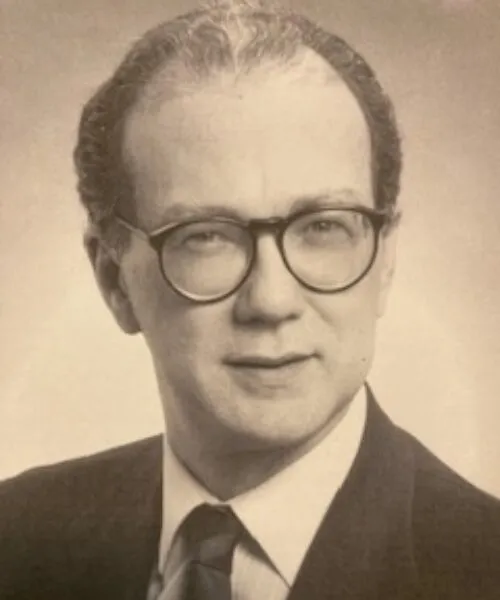
About G. David Peters
G. David Peters is a recognized leader and pioneer in the fields of computer-based education, computer-based music instruction CBMI , and technology-based music instruction (TBMI). He has been a musician, educator, higher education administrator, business leader and arts advocate.
Professor Peters joined the music education faculty in 1970 teaching instrumental methods after serving as Director of Bands at Texas Southern University for four years. He earned a Bachelor of Music Education degree from the University of Evansville, a Master of Science in Music Education and an EdD from the University of Illinois (UIUC) and was the first to receive a doctoral degree from UIUC that specialized in computer-based music instruction and pitch detection of music performance (Peters 1973).
Peters was a founding member and past President of the National Consortium for Computer-Based Instruction Systems (NCCBMI) that was established in 1975. The NCCBMI name was changed to the Association for the Development of Computer-Based Instruction (ADCIS) in 1992. He was President of the Music Industry Council, an association of music businesses, manufacturers and publishers that support the Music Educators National Conference (MENC) from 2000 to 2002. Peters was a member of the MENC National Executive Board from 1998 – 2002 and also served as Chair of Electronic Music and Music Technology at ten national MENC conferences. He served on national executive boards of non-profit organizations promoting arts in schools and communities. Dr. Peters served as professor and chair of music education at the University of Illinois for 17 years. As an administrator at UIUC, he served as Assistant Dean for seven years, then Associate Dean for three years of the College of Fine and Applied Arts. He counselled and mentored numerous students who went on to academic and personal success. During his tenure at Illinois, Peters authored and designed software at the prestigious Computer-Based Education Research Laboratory (CERL) using a mainframe computer system, named PLATO. He was founder and director of the PLATO Music Project at the University of Illinois from 1970 through 1988. His doctoral research required the invention of a hardware interface for the PLATO III computer to judge pitch and rhythmic accuracy of trumpet students playing standard music etudes. This groundbreaking research was the basis for numerous performance-judging software applications used today such as Audio Mirror (ECS Media 1984), Amadeus (Pygraphics 2002), and SmartMusic (Make Music 2006). Peters and his graduate students developed the first multimedia computer-based software applications for music instruction ever created using the PLATO system as early as 1973. In addition, from 1974 until 1985, over 40 graduate students assigned to the PLATO Music Project developed instructional software for the UIUC music faculty. Seventy-five programs in music were developed for the PLATO IV computer system for instruction in music theory, music appreciation, percussion terminology, instrumental teaching methods, choral conducting, ear training, music evaluation and assessment, and other related music areas.
The PLATO Music Project was renamed as the Illinois Technology-based Music Project in 1985 to accommodate the emerging microcomputer applications being developed at Illinois by Peters and his colleagues. Use of Apple Macintosh and IBM PC computers was applied to music instruction, pitch detection and early video-based tutorials. Another emerging hardware used for technology-based music instruction was video-disc technology. Peters was an author and co-developer for the Delaware Videodisc Project (Hofstetter 1985) funded by the National Endowment for the Humanities to investigate the impact that random-access video could have on teaching music literature, music history and music theory. One of his UIUC doctoral students, Anne Miller (1987) used the same video disc tools, then attached the video disc player to a PC computer to develop and test interactive video tutorials for oboe students learning to prepare and adjust oboe reeds. Peters received funding through an Apple Strategic Development Grant in 1993 to create digitized music video software content to test the viability of multimedia presentation of three projects: violin vibrato, trombone embouchure demonstration and piano scale fingerings. The video clips were developed as an Apple Macintosh computer-based series for music education students.
In order to expand the scope of computer-based music instruction beyond the PLATO computer-based education system, Peters worked with others to found companies to develop and publish music software for use in schools, private music studios and colleges. He observed and determined that schools and home users of instructional software would shift to the less expensive computer platforms designed and produced by Apple, Atari, Commodore, Texas Instruments and later IBM. Professor Peters is the author of numerous articles, sixty music software programs, three books and twenty published music compositions. He co-authored two books related to music learning and computer instruction. Guide to Successful Computer Instruction (Peters and Eddins, 1981) and Music Teaching and Learning (Peters and Miller 1982). As a result of his research, he authored a major report entitled, Musical skills: A computer-based assessment of computer-based music performance assessment (Peters 1992) detailing his research that was funded by the National Endowment of the Arts and the United States Department of Education. He served as editor to scholarly journals including the Journal for Computer-Based Music Instruction. His published articles focused on music performance techniques, music software applications, music technology laboratory design, and curriculum design for technology facilities.